


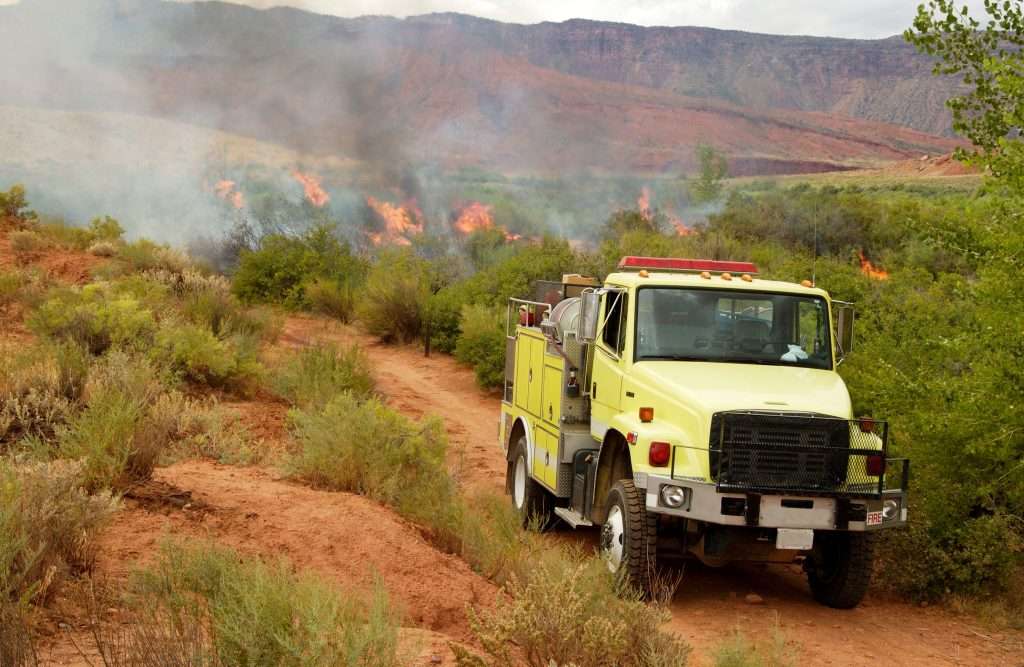
Wildfire seasons are getting longer. The wildland-urban interface is expanding. And rural and volunteer departments that have never had to think much about wildland response are now finding themselves on the front lines of brush fires, grass fires, and interface incidents they weren’t equipped to handle.
The problem is that most departments shopping for wildland capability don’t know where to start. The used apparatus market can feel like a maze of types, configurations, and specs that only make sense if you already know what you’re looking for. But Bradford Fire Apparatus is here to help.
This guide breaks down the NWCG wildland fire truck types and wildland fire engine types, explains what Type 3, 4, and 6 engines actually mean in the field, and walks you through what to look for when evaluating a used brush truck for sale or wildland pumper.
If your department is building out its wildland capability, this guide will help you shop with confidence.
When fire departments, state agencies, and federal agencies talk about wildland fire truck types, they’re referring to a classification system maintained by the National Wildfire Coordinating Group (NWCG). The type system exists to create a common language for mutual aid. When a department orders a Type 3 fire apparatus for an incident, everyone knows what’s showing up.
Each engine type is defined by minimum requirements for tank capacity, pump flow, hose load, crew size, and in some cases maximum GVWR. For departments buying used apparatus, understanding this system helps you shop smarter, communicate clearly with dealers, and ensure the truck you buy will qualify for mutual aid assignments if that matters to your department.
The three wildland fire engine types most commonly found in the used apparatus market are Type 3, Type 4, and Type 6.
Type 3 fire apparatus is the backbone of wildland fire suppression in the United States. It’s the most common wildland apparatus on federal and state fire assignments. It’s also the type most departments should evaluate first when building initial wildland capability.
NWCG Minimum Requirements:
Type 3 fire apparatus is typically built on a 4×4 commercial chassis. That gives it the off-road capability to operate in rough terrain without requiring a purpose-built military-style platform. It’s large enough to carry meaningful water and equipment. It’s also maneuverable enough to work brush roads and interface areas that a structural pumper couldn’t access.
Need a truck that can handle wildland assignments, protect exposures in interface situations, and assist with rural structural fires from the exterior? Type 3 fire apparatus is often the answer.
The Type 4 engine makes a trade-off that confuses a lot of buyers. It carries more water than a Type 3 but has a significantly smaller pump. The result is an apparatus better suited to mop-up, exposure protection, and sustained rural structure defense than to active initial attack on fast-moving fires.
NWCG Minimum Requirements:
Type 4s show up most often in rural and agricultural departments. These are departments where having a large water supply on the truck matters more than high pump output. If you’re looking at a pumper tanker for sale in the used market, a Type 4 is worth evaluating. It’s a strong fit for departments whose wildland calls involve protecting structures or mop-up work rather than direct initial attack.
The Type 6 is the light attack unit of the wildland world. It’s typically built on a 3/4-ton or 1-ton pickup chassis. It’s fast enough to get ahead of a fire and nimble enough to reach terrain that a larger apparatus simply cannot.
NWCG Minimum Requirements:
Type 6 engines are ideal as a first-due wildland response unit. They work especially well for departments that cover large rural areas where getting water on the fire early matters more than carrying a large supply. Many departments run a Type 6 alongside a larger tanker or structural engine rather than as a standalone wildland solution.
In the used apparatus market, Type 6 units — the category most commonly searched as brush fire trucks for sale — represent some of the best value available for departments entering wildland response on a tight budget.
The right answer depends on your mission profile. Ask yourself these questions before you decide.
What terrain do your wildland calls involve? Type 6 units work best in tight, rugged terrain where a larger apparatus would struggle. Type 3 fire apparatus offers more capability for sustained operations in moderate terrain.
Do you need mutual aid qualification? If your department contributes resources to regional or national wildland incidents, Type 3 fire apparatus is the standard most agencies request. A Type 6 may not qualify for certain assignments.
Are you supplementing an existing fleet or building from scratch? A department with a strong tanker program may only need a Type 6 for initial attack. A department starting from zero will likely want a Type 3 fire apparatus as its primary wildland unit.
What’s your budget? A used brush truck for sale is the most accessible entry point for departments with limited capital. A clean used Type 3 fire apparatus costs more but delivers significantly more capability.
Wildland apparatus takes a different kind of abuse than structural trucks. Off-road operation, rough terrain, high hours, and exposure to extreme heat and smoke all take a toll. Used 4×4 fire trucks for sale need a more thorough evaluation than a used structural pumper. Here’s what to focus on.
4×4 drivetrain. This is the most important mechanical system on any off road fire truck. Inspect the front axle, transfer case, and differential locks. Have a qualified technician check for leaks, excessive wear, and proper engagement of all drive modes. A compromised 4×4 system will fail you at the worst possible moment.
Pump and plumbing integrity. Wildland pumps work differently than structural pumps. They run at high pressure, often in pump-and-roll mode, and sometimes sit unused for long periods. Check for corrosion, cracked fittings, and compromised seals. A pump test is non-negotiable.
Tank condition. Poly tanks are common on wildland apparatus. They hold up well but can crack at mounting points. Steel tanks can corrode from the inside out in ways that aren’t visible externally. Ask when the tank was last inspected and cleaned.
Hours versus miles. Wildland apparatus accumulates engine hours during pump operations without adding road miles. A truck with 40,000 miles and 4,000 engine hours has worked much harder than the odometer suggests. Always ask for the hour meter reading.
Chassis condition. Check ground clearance, approach and departure angles, suspension condition, and skid plate coverage. This matters especially when evaluating any used 4×4 fire truck for sale that spent years on active fire lines.
CAFS system condition, if present. Compressed Air Foam Systems add real capability for wildland operations. They also require careful maintenance. If a used truck has CAFS, have it inspected by a technician who knows the system before you commit.
At Bradford Fire Apparatus, every used brush truck for sale on our lot is inspected and pump-tested by EVT-certified technicians before it leaves our facility. Our president Jim Bradford spent 30 years in the fire service — including Air Force Crash Fire Rescue training. That experience informs how we evaluate every piece of apparatus we take in. We know what to look for because we’ve operated this equipment ourselves.
New Type 3 fire apparatus regularly costs $300,000 or more. New Type 6 brush trucks run $80,000–$150,000 depending on configuration. For rural and volunteer departments on tight budgets or relying on FEMA Assistance to Firefighters Grant funding, new wildland apparatus is simply out of reach.
Used wildland apparatus changes that equation.
A well-maintained used Type 3 fire apparatus or Type 6 delivers the same operational capability at a fraction of the cost. That lets departments build wildland response capacity without gutting other budget priorities. Bradford Fire Apparatus offers financing options to spread the cost further — another tool for making wildland capability accessible on a department budget.
Most wildland apparatus runs on a standard 4×4 chassis. That’s adequate for the majority of wildland operations. But some terrain demands more: deep mud, loose aggregate, steep grades, heavily rutted fire roads. In those conditions, a 6×6 all-wheel-drive configuration offers a real advantage.
A 6×6 drives all six wheels simultaneously. That distributes power more evenly across the axles and keeps the truck moving in conditions where a standard 4×4 fire truck for sale would get stuck or lose control. For departments in mountain terrain, heavy clay agricultural areas, or rugged interface zones, the added capability is worth the premium in the used market.
Bradford Fire Apparatus periodically carries 6×6 wildland apparatus in inventory. Check our current used fire truck listings for available units.
Whether you’re searching for a Type 3 fire apparatus for initial attack, a used brush truck for sale for light response, or a heavy 6×6 tanker for interface protection, Bradford Fire Apparatus can help. Our inventory changes regularly, and our team brings over 50 years of fire service experience to every transaction.
Browse our current wildland and brush truck inventory or contact us to talk through your department’s wildland mission. We’re here to help you find the right truck — not just any truck.
A Type 3 fire apparatus is a wildland engine defined by the National Wildfire Coordinating Group (NWCG). It must carry a minimum 500-gallon water tank, pump at least 150 GPM at 250 PSI, and support pump-and-roll operations. Type 3 fire apparatus is the most common wildland engine on federal and state fire assignments. It’s typically built on a 4×4 commercial chassis.
Size, water capacity, and intended use. Type 3 fire apparatus carries a minimum 500-gallon tank and pumps 150 GPM. It’s built for sustained wildland and interface operations. A Type 6 carries a minimum 150-gallon tank and pumps 50 GPM. It’s a lighter, faster initial attack unit built on a pickup truck chassis. Type 3 fire apparatus suits departments that need mutual aid qualification. Type 6s are the most cost-effective entry point into wildland response.
Check the 4×4 drivetrain, pump and plumbing integrity, tank condition, and engine hours alongside mileage. Any used brush fire trucks for sale should be evaluated by an EVT-certified technician with experience in off-road apparatus before purchase.
Yes — and it should be. EVT certification means the technicians who inspected and serviced the apparatus are credentialed specifically for fire apparatus work. At Bradford Fire Apparatus, all inspections are performed by EVT-certified, pump-certified technicians. Learn more about what EVT certification means and why it matters.
A 6×6 fire truck drives all six wheels simultaneously. It provides superior traction in demanding off-road conditions. These units are common among used 4×4 fire trucks for sale in the heavy wildland category. They’re used in mountain terrain, agricultural areas, and rugged interface zones where standard 4×4 capability isn’t enough.